
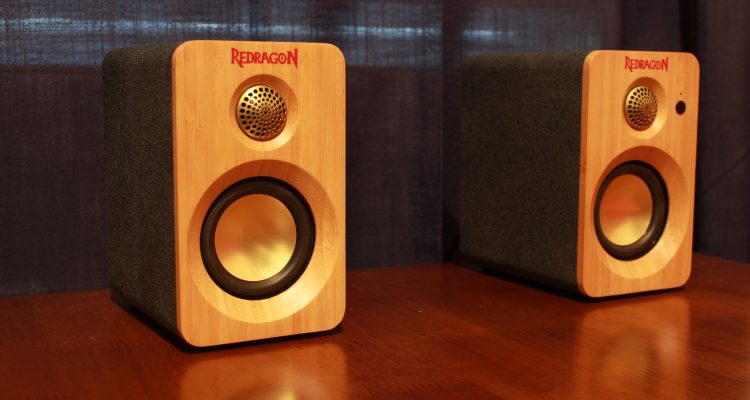
I wasn’t expecting much from the Redragon IMPACTSPHERE GS818.
They’re tiny desktop speakers with 3-inch mid-bass drivers, and before I ever heard them I had already formed an opinion about what they were probably going to sound like: thin, a little tinny, weak on the bottom end, and generally like a typical set of inexpensive computer speakers.
I was wrong.
The first thing that surprised me wasn’t the bass or how loud they could play. It was the clarity. These little speakers sound remarkably clean and detailed for their size, and they manage to have enough weight behind the sound that they don’t immediately announce themselves as tiny desktop speakers.
After listening to them for a while, I broke out REW and my RØDE NT-USB Mini to see if I could figure out what was going on.
The measurements helped explain quite a bit.
Redragon GS818 Specifications
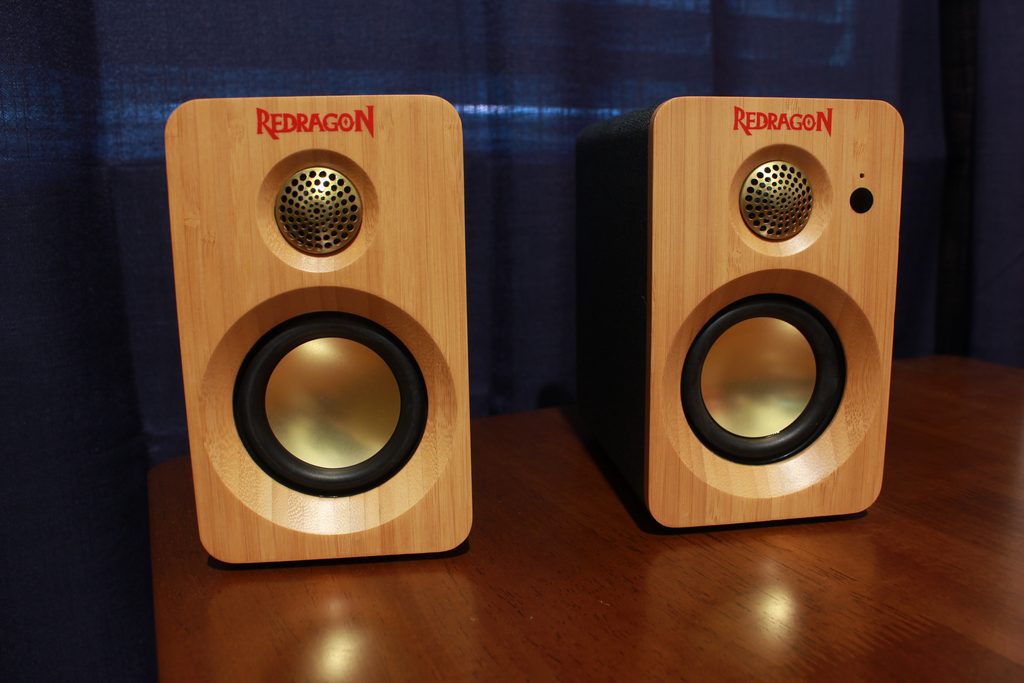
The GS818 is a compact powered 2.0 system measuring only 3.94 inches wide, 6.85 inches tall and 6.17 inches deep per speaker. Each enclosure contains a 3-inch aluminum-cone mid-bass driver and a 1-inch transparent silk-dome tweeter, with a rear-firing bass-reflex port helping the small cabinet make the most of its limited low-frequency output. Redragon rates the system for 60 watts maximum output and specifies a frequency response of 45 Hz to 20 kHz with a signal-to-noise ratio of at least 85 dB.
Connectivity is unusually good for an $80 desktop system. You get Bluetooth 5.3, a traditional 3.5mm AUX input and USB-C. The USB-C connection isn’t just for power; Redragon has built a digital sound card into the speakers, so they can receive audio directly from a PC or laptop over USB. There’s also a dedicated subwoofer output.
The speakers provide Music, Movie and Dialog listening modes along with adjustable bass and treble. That makes the GS818 considerably more flexible than a basic powered desktop speaker.
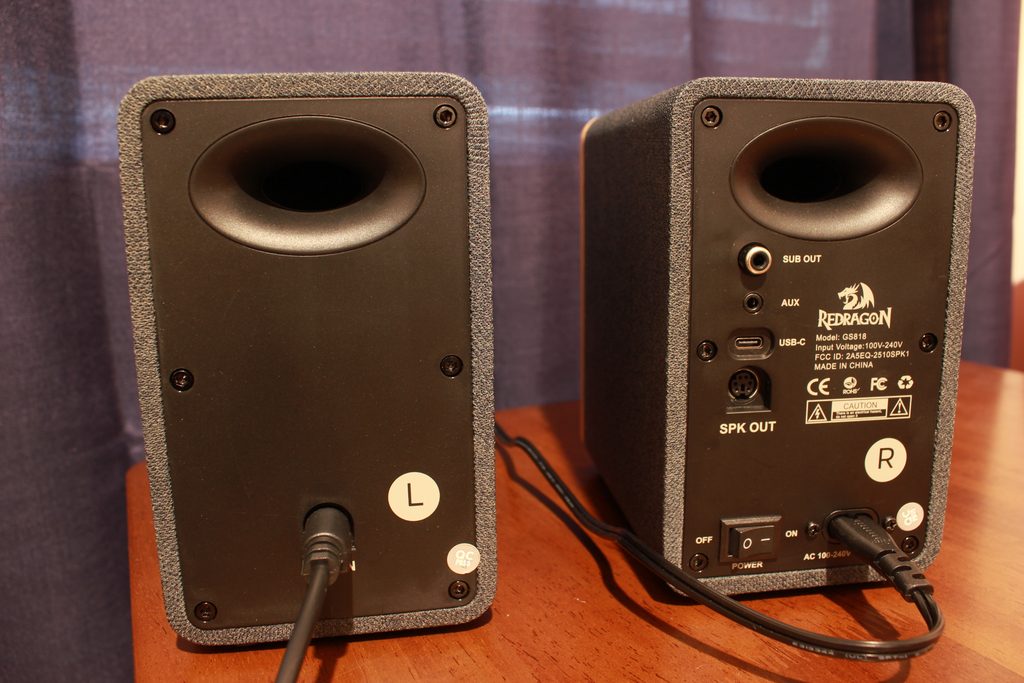
And that subwoofer output is particularly welcome. As we’ll see in the measurements, there is a point where physics catches up with the GS818. Rather than pretending a 3-inch driver can replace a subwoofer, Redragon gives you a straightforward way to add one.
Interested in the Redragon IMPACTSPHERE GS818?
Save 10% when you purchase directly from Redragon.
Affiliate link — I may earn a commission from qualifying purchases at no additional cost to you.
They Look Better Than I Expected, Too
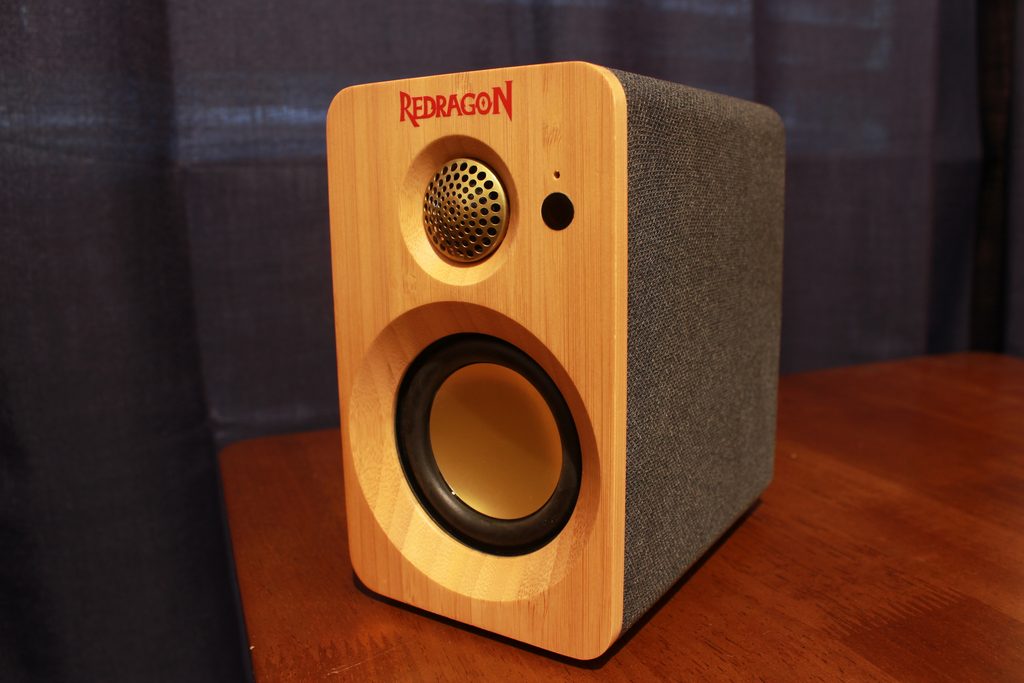
The GS818 doesn’t look like the stereotypical inexpensive computer speaker.
The natural wood front contrasts nicely with the black fabric-covered cabinet, and the exposed aluminum mid-bass driver and tweeter give the speakers more of a miniature bookshelf-speaker appearance.
They’re also genuinely small. At less than four inches wide, they take up very little desk space.
That’s part of what made my first listen so surprising. Looking at these sitting on a desk does not prepare you for the sound that comes out of them.
My First Listen
I fully expected these speakers to sound tinny.
They don’t.
I expected them to have that small-speaker character where voices and instruments are present but don’t have much body behind them.
They don’t really do that either.
Instead, the GS818 sounds clear, lively and surprisingly full for something this small. Vocals are easy to understand, instruments have good separation, and there’s enough punch in the upper bass to keep music from sounding anemic.
What they don’t have is deep bass.
And frankly, I wouldn’t expect them to.
We’re asking a 3-inch driver in a cabinet barely larger than my hand to reproduce low-frequency energy. There is only so much air a driver that size can move. No amount of marketing or DSP gets to repeal physics.
What surprised me is how effectively the GS818 works around that limitation.
Measuring the GS818 with REW
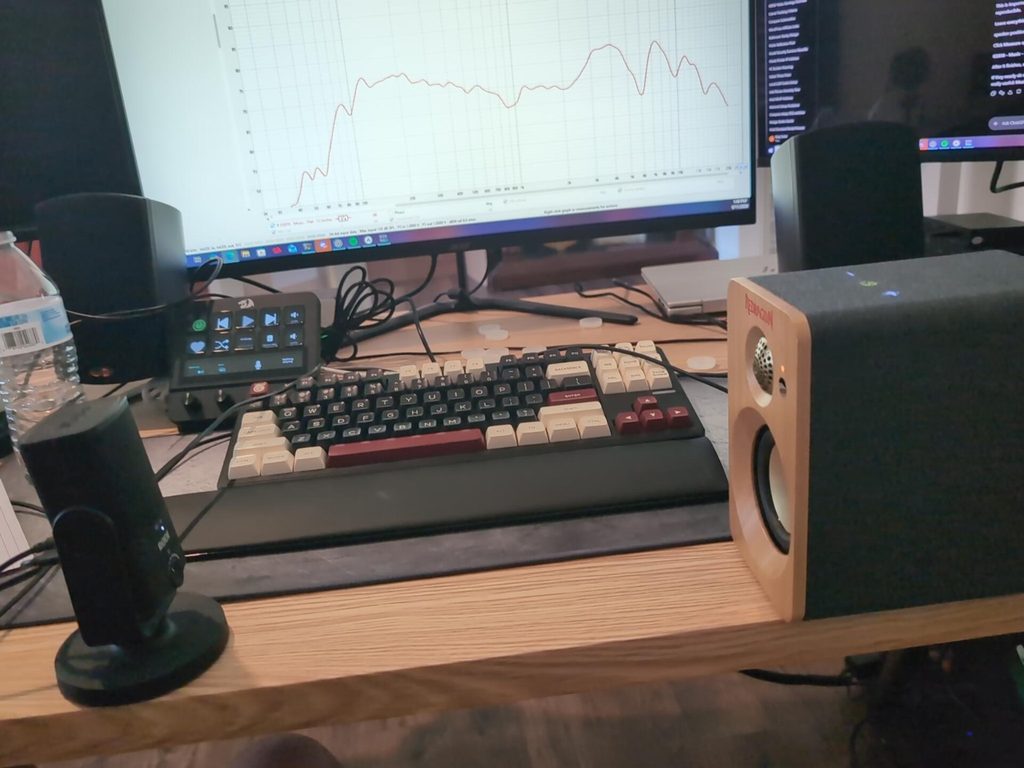
For some objective context, I measured the GS818 using Room EQ Wizard (REW) and a RØDE NT-USB Mini.
The microphone was positioned approximately 12 inches from the speaker, aimed between the woofer and tweeter. The sweep covered 20 Hz to 20 kHz, and the resulting graph was displayed with 1/6-octave smoothing.
As with my previous speaker testing, this is not a laboratory-grade measurement. The RØDE NT-USB Mini is a recording microphone, not an individually calibrated measurement microphone, and the test was performed in a normal room rather than an anechoic chamber.
The measurement is useful for examining broad frequency-response trends, not for claiming accuracy to fractions of a decibel.
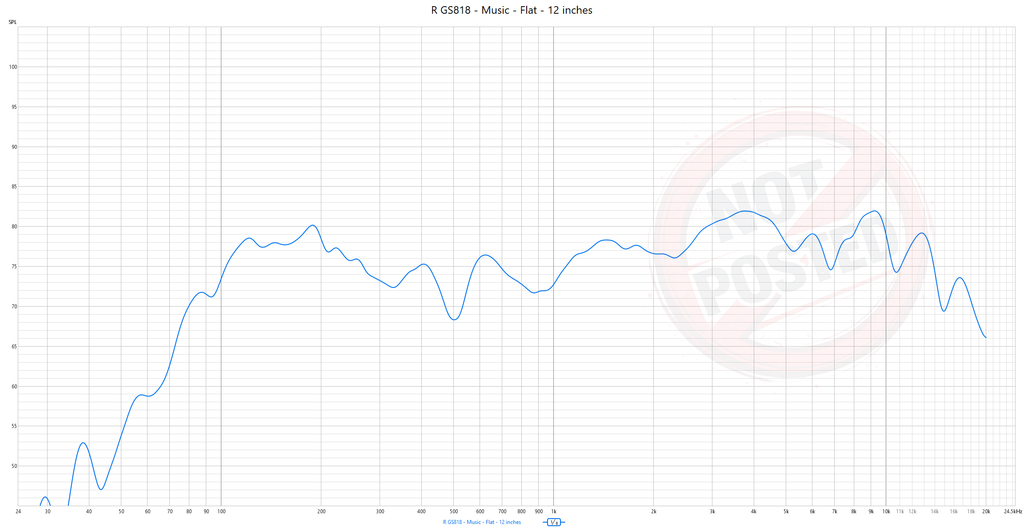
And this graph explains quite a bit about what I heard.
About That 45 Hz Specification…
Redragon specifies the GS818 at 45 Hz–20 kHz.
Technically, the speaker may produce output at 45 Hz. My measurement certainly detects some.
But there’s a major difference between producing a frequency and producing it at a level that is useful relative to the rest of the speaker’s output.
The GS818 begins rolling off substantially below roughly 70–80 Hz in my measurement. By the time it reaches 45 Hz, output is far below the speaker’s normal operating level.
In other words, I would not interpret “45 Hz” as meaning these little speakers deliver meaningful flat bass into the 40-Hz range.
They don’t.
That’s not particularly surprising. Again: 3-inch woofer. Tiny cabinet. Physics.
What is considerably more interesting is what happens above that roll-off.
How a Tiny Speaker Creates the Impression of Bass
Look at the area from approximately 100 to 200 Hz.
There’s a noticeable amount of energy there compared with the lower midrange.
I don’t think that’s accidental.
The GS818 can’t produce much deep bass, so instead it appears to emphasize the region that a small driver can reproduce effectively. That gives bass guitars, kick drums and other low-frequency sounds more weight and punch even though the lowest fundamentals aren’t being reproduced at the same level.
It’s a clever bit of voicing.
You don’t suddenly hear 40-Hz bass that isn’t there. Instead, your ear receives enough upper-bass information that the speaker doesn’t sound nearly as small as it actually is.
That distinction is important.
I wouldn’t describe the GS818 as a bass-heavy speaker.
I’d describe it as a small speaker that is very good at making the bass it can reproduce count.
And if you actually want deep bass, that’s what the subwoofer output is for.
These Are Not Neutral Speakers
There’s another interesting part of the graph.
The GS818 doesn’t measure ruler-flat through the midrange and treble. There are several dips and rises, with one of the most obvious broad characteristics being additional energy in the presence region around roughly 3–4 kHz.
That matters because this is an area that contributes strongly to the perceived presence and definition of vocals and instruments.
And suddenly my first impression makes a lot more sense.
Clarity.
The GS818 isn’t simply reproducing everything neutrally and somehow overcoming its physical size. It appears to be voiced to sound lively, clear and larger than it is.
There’s upper-bass emphasis to add body and a stronger presence region to bring detail forward.
That’s not neutral.
But neutral and good aren’t synonyms.
For a studio monitor, I would want accuracy to take priority. For an $80 desktop speaker designed for music, games, movies and general computer use, I’m much more interested in whether the tuning makes the speaker enjoyable.
Here, I think it does.
The GS818 is using the frequencies its small drivers can reproduce well to compensate for the frequencies they physically can’t.
The result is a speaker that punches considerably above its size.
Music, Movies and Dialog
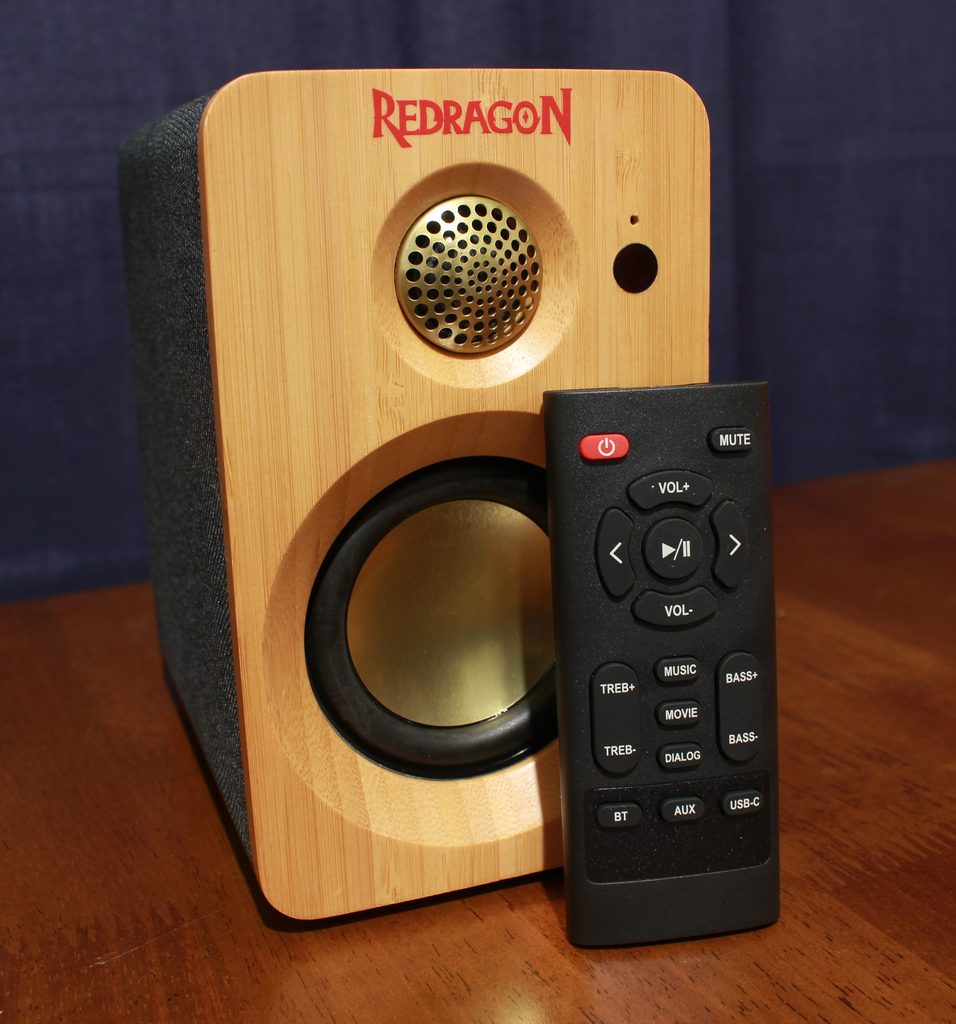
The GS818 also provides three sound presets: Music, Movie and Dialog, along with independent bass and treble adjustment.
That means you’re not necessarily stuck with one factory voicing.
Music was my starting point for both listening and measurement, but the other modes give you some flexibility depending on what you’re doing. Dialog is particularly useful for spoken content, while Movie mode provides another presentation for video and gaming.
The ability to adjust bass and treble separately is also something I appreciate. Small powered speakers increasingly rely on DSP, but many manufacturers give the user no control over what that DSP is doing.
Redragon does.
Three Ways to Connect
The connectivity may be one of the GS818’s strongest features.
Bluetooth 5.3 handles phones and tablets. AUX means they’ll work with essentially any conventional analog source. USB-C lets a computer send digital audio directly to the speakers through their internal sound card.
For a desktop setup, USB-C is probably the cleanest solution. There’s no need to depend on the quality of the computer’s analog headphone output.
Then there’s SUB OUT.
That turns the GS818 into the foundation of a compact 2.1 system rather than something you necessarily have to replace if you later decide you want deeper bass.
For speakers this small and inexpensive, that’s an excellent inclusion.
So, Are the Redragon GS818 Speakers Actually Good?
Yes.
Not “good considering they’re tiny.”
Not “good for computer speakers.”
They’re simply good little speakers, with the obvious limitation that something this small isn’t going to produce deep bass.
What impressed me most is how well the GS818 works within its physical limitations.
The measurements help explain what I was hearing. Instead of producing deep bass that a driver this small simply can’t deliver, the GS818 has a noticeable boost in the upper-bass region. That gives it more punch and weight than I expected from a 3-inch speaker.
The 3-inch driver can’t give you real sub-bass, so the speaker puts useful energy into the upper-bass region where it can provide some punch. The response isn’t completely neutral, but the voicing emphasizes clarity and presence in a way that makes the GS818 sound much more substantial than its dimensions suggest.
Add Bluetooth 5.3, USB-C digital audio, AUX, multiple DSP modes, bass and treble adjustment, a subwoofer output and an attractive compact enclosure, and the $79.99 asking price starts looking pretty reasonable.
If absolute neutrality is the goal, there are better choices.
If you want deep bass without a subwoofer, there are definitely better choices—and they’re going to be considerably larger.
But if you want a pair of genuinely tiny desktop speakers that look good, take up almost no room and sound far better than their size suggests, the GS818 surprised me.
I went into this review expecting to explain why a 3-inch desktop speaker couldn’t sound particularly good.
Instead, I ended up trying to explain why it does.
Interested in the Redragon IMPACTSPHERE GS818?
Save 10% when you purchase directly from Redragon.
Affiliate link — I may earn a commission from qualifying purchases at no additional cost to you.


No Comments on "Redragon IMPACTSPHERE GS818 Review — These Tiny Desktop Speakers Shouldn’t Sound This Good"